
Beyond the lake: An unplanned lesson in trust and survival in Turkish mountains
Mountains Experiences – Chapter 2
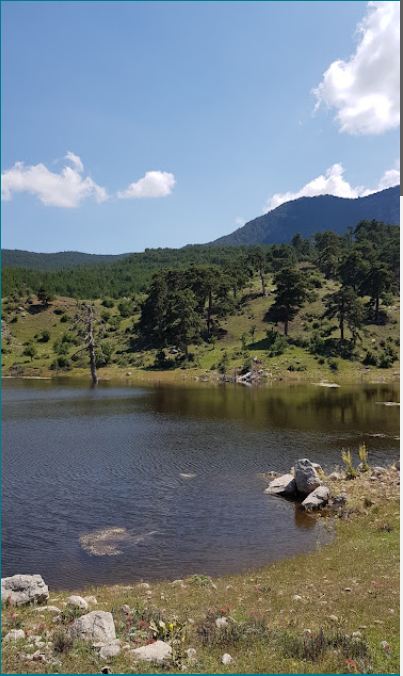
The next day I set out on a trip to a small mountain lake I had read about, hoping to see something a little different.
The minibus dropped me on the main road near a turnoff leading to a narrow road that climbs into the mountains, passing several villages and also leading to the lake. I had walked less than a hundred meters when an old car with a father and son stopped beside me without me even signaling, and I got in. It was clear to me that any car stopping would help shorten the distance, since this was the only road in the area. After a few kilometers they reached their home and told me to continue on foot, as the lake was no longer far.
I enjoyed the walk. It was a very pleasant, sunny day in May, surrounded mostly by agricultural fields, with lots of quiet and a view of the wide valley spread out below. Sometimes I even prefer walking when it’s in nature and on a mild, sunny day—to feel it with my eyes, legs, ears, and senses. That’s how I imagined it would be until I reached the village next to the lake. Still, I didn’t refuse when a farmer on a tractor arrived and motioned for me to climb aboard. I knew I would get on, and I reached out my hand to grab the seat behind him and… boom.
A massive storm hit me in a single second.
Do you know that feeling when your brain already knows that in less than a second a major disaster is about to happen, yet your body hasn’t processed it, even though you know it’s coming?
That’s exactly what happened. I will remember that half-second for years—perhaps for the rest of my life.
I’m not experienced with riding tractors. In fact, only the day before had I ridden one for the first time. It turned out to be an old tractor with the exhaust pipe located near the driver, and that was exactly what I gripped tightly with my left hand in order to pull myself up.
The realization that something terrible had happened was immediate, and I jumped back to the ground in panic. The driver, who quickly understood the disaster, muttered words in Turkish, his face showing that he shared the weight of the moment. The pain—from metal heated to 300 degrees—flashed instantly. The skin tore open, revealing pink and red layers. I quickly handed him my water bottle to pour over my hand. The relief was immediate and addictive—I didn’t want it to end. In an illogical, unreasonable decision driven by that temporary relief, I chose to climb back onto the tractor and continue to the lake, because that was why I had come all this way. I still didn’t fully grasp the meaning of what had happened or what it implied.
Within two or three minutes we reached the village. He continued on toward one of the nearby fields and pointed me in the direction I needed to walk to reach the lake. The walk was short and I arrived quickly, but my hand screamed with relentless pain. Only water—from outdoor taps or from families whose courtyards I asked to use—helped ease it. I don’t really remember the lake, but the memory of the pain has stayed with me vividly to this day.
I could no longer bear the burning intensity and decided to return to the city to seek medical help. On the way, I saw a family sitting in the yard of their home, in a wide, green garden. I went in and, with very few words, managed to explain what had happened. There was no need for many explanations—they could see it with their own eyes.
They quickly told me to sit down, brought water and coffee, dry ice to cool the burning area, and an ointment to numb the pain.
Only then—when someone saw me, understood the immense pain I was experiencing, and helped me during one of the hardest moments of my life—did I feel that I could stop for a moment and slowly breathe. I couldn’t believe this had happened to me. Tears began to roll down my cheeks as I realized I was now in better hands, that someone was taking care of me. When I looked at them, they understood this too, smiling.
Within minutes they called the father, who told me to get into an old, battered car to take me down to the main road, where I could catch a bus to the city. He insisted on taking no money despite my repeated offers, and I said goodbye with gratitude—and with a cool plastic ice pack that helped greatly to reduce the pain in my hand.
Within a minute a minibus arrived, and I boarded immediately. Just before the minibus reached the central station in Denizli, I was relieved to spot a public hospital. I breathed deeply with great relief, crossed the main road, and went inside.
After a short wait, the clerk who saw me and my hand immediately said, “You need the emergency room—come, I’ll take you there.” We quickly passed through several corridors and staircases and arrived at the ER. “Stand here,” she told me, “for registration, and then treatment.”
I waited behind two or three patients, but the nurse, seeing my intense suffering as I waved my hand rapidly to catch a cool breeze, said, “Let’s treat you first. You’ll feel better, and we’ll take care of the paperwork afterward.” I felt enormous relief.
“It’ll be okay—within just a few minutes you’ll feel much better,” she said, and I didn’t believe her. She took me to a side room, where I sat on the bed as she mixed several different ointments and applied the mixture to my hand.
Very quickly I felt immense relief. Almost all of the pain subsided. I could begin to breathe deeply again. I could suddenly think about things other than pain and fear. I could start to calm down and understand what was happening to me and around me.
I could see hope.
“I hope you’re feeling better. You need to change the dressing every day, and it’s important not to get it wet. Take care,” the nurse said, and I felt that I was truly in good hands.
I took care of the registration and payment, picked up all the medications from the nearby pharmacy, and returned to my room—which suddenly felt so inviting and peaceful that I could have spent the entire day there resting.
Only then did I understand: even if I have goals in life that I am determined to achieve, it is important to stop for a moment, to see myself within the moment, and to understand that seeing myself and listening to myself matters more than seeing yet another mountain lake—even the most beautiful one I have ever seen.
And I also understood that if help is needed—no matter where I am in the world, in remote places, in the mountains, in the desert, or in a foreign city—there will be someone who will take care of me, if only I ask.
These are things I will carry with me for the rest of my life.
/